Archive for the ‘the forthcoming apocalypse’ Category

The agency:publisher distinction

Monday, September 26th, 2011

I’ve been planning this post expanding on what I think of agencies offering self-publishing services to authors. I think a lot of things, unsurprisingly, and I keep thinking more of them as time goes on.

But I do want to say something about the increasing…fetishization? Mantra? that I’m hearing from agencies offering these services, and that goes like this: “We’re not a publisher!” This is held up as if it is somehow the magic distinction between creating an irresponsible conflict of interest and being a-okay.

I think this is kind of a weird thing to focus on. I’m a publisher right now. I can tell I’m a publisher because I get editing services for my books, provide covers, format them, and then distribute them to venues. I really don’t understand why an agency which engages in the same things isn’t effectively functioning as a publisher, too. I can understand that, for purposes of clarity, an agency might not want to be called a publisher–but if it looks like a duck, and quacks like a duck, et cetera et cetera.

But this is a little bit disingenuous on my part. Agents might look and quack like ducks not because they are ducks, but because they are acting on behalf of ducks. And so that’s why I think that tossing around the publisher label is a bit of a red herring. The distinction between “providing appropriate services to agency clients” and “engaging in an unethical conflict of interest” has nothing to do with whether the agency is a publisher, and everything to do with on whose behalf the agency is acting.

Let me give you an example that I think shows the distinction. I sold Harlequin world rights to four books. At this point, I could not say to Harlequin, “Do not sell any more foreign rights. I will not agree to it.” That is because Harlequin decides whether to license foreign rights based on its own considerations, and its own bottom line. It doesn’t have to care about me and what I think at all. I have given up the rights to object to their distribution of the books by contract, and I can’t take that back.

By contrast, if my agent shops the foreign rights for my book to publishers, and gets offers, she will present them to me. I can look at all the offers she gets, and I can say, “No. I’m not taking any of those.” And you know what? She has to suck it up. If I’m really obnoxious about it, she can drop me as a client–that’s perfectly within her rights. But she can’t make me take an offer. That is because my agent isn’t selling my book on her own behalf; she is selling it on my behalf.

By analogy. If an agent is providing publishing services, she is engaging in publisher-like activity. Whether you call her a publisher or not is a question of semantics. Whether she has a conflict of interest, however, is not. If she is not engaging in a conflict of interest, she must be publishing on the author’s behalf, and not on her behalf as a publisher. Consider the following scenarios:

  • An agent can provide all the things that are listed on its service list (editing, formatting, cover art). The author decides–after that expenditure of money and time–that she no longer wants to self-publish the work. An agent who is publishing on behalf of the author, rather than on behalf of herself–cannot publish the work.
  • An author decides that, to show her solidarity with workers, she will not publish her work on a particular venue because of reports of working conditions, and asks the agent to pull her self-published works from that venue entirely. 70% of the revenue from the self-published work come from that venue. An agent who is publishing on behalf of the author must pull the book from that venue.

If the contract between the author and the agent is such that the above would not happen, it’s probably because the agent is demanding that the author give her distribution rights directly, instead of distributing on behalf of the author. That, to my mind, looks like a conflict of interest. It looks like an agent who is publishing on her own behalf instead of on behalf of the author.

You’ll notice that under my scenario, there is a substantial chance that an author could screw an agent. That has always been the case: authors have always been able to sign with an agent, take editorial advice, and then yank the manuscript pre-submission and sell it through someone else. Authors have always been able to say “no” to insanely good offers that agents work very, very hard to get. The only way that I can imagine that an agent could completely insulate herself from bad behavior on the part of the author in supplying self-publishing services would be to demand exclusive rights to distribute the work–which in effect, would mean that she was publishing the book on her own behalf, instead of on behalf of the author.

(Of course, the way the agent insulates herself from this sort of behavior from reasonable authors is by providing the author with more value than she takes in by way of revenue.)

So in my mind that’s really the salient question. Not, “Is this agency a publisher?” but “Is this agency acting on behalf of the author?”

P.S. You might notice that I have a book out tomorrow! It is called Unclaimed, and I desperately love this book, and the hero of this book. I have been silent because I am desperately working on finishing another book. I promise to say more, and soon!

agency publishing and conflicts of interest

Wednesday, July 27th, 2011

This is a very long blog post about why I believe it is unethical for agents to publish their clients.

Before I start, I just want to encourage people who disagree with me to speak up more. Blog posts can take on a bit of an echo-chamber approach, and I know everyone who read my last post didn’t agree with it. It’s okay to disagree. And the fastest way to hash things out in a changing industry is to actually talk to each other, instead of going and sending furious e-mails to friends and creating an echo chamber of your own. You can call me whatever names you want. You can tell me why I’m wrong. I won’t mind. In fact, I approve. But since I’m also trying to finish a book, I’m turning off my internet for the vast majority of the morning, and so I probably won’t even know until I hurriedly read through everything in the afternoon.

That also means I’m not going to be able to do much policing or moderation until I get home–and my apologies for that.

Also, please read my post from earlier this morning. Yesterday’s open letter to agents painted with too broad brushstrokes. I’m appalled by what some agents are doing, but I have also been so heartened by the way that other agents have reacted. Many agents have deep integrity and respect for their clients, and are doing their best to become experts over a field that is changing so fast that even the main players scarcely understand what’s happening. They’re doing their best to guide their clients through these changing times. I shouldn’t have implied that all agents were at fault.

Where I’m coming from.

It’s not a surprise to long-time readers of this blog that my background is as a lawyer. That means that when I talk about professional conduct, I’m talking about it from the point of view of someone who’s in a profession which is often maligned for its lack of ethics–and that means that those of us who care deeply are taught, and required to remind ourselves on a regular basis what ethics mean.

But we’re not just aware of ethical behavior for lawyers. Lawyers are often required to counsel other clients about the appropriate standard for behavior. Lawyers counsel corporation board members, doctors, and so forth on the appropriate standards for ethical behavior. We have to think about what professional occupations are, what they do, and what purpose they serve.

If you haven’t already been able to tell, I try to walk as upright a road as I can in everything that I do. That means that I take the concept of professional ethics very, very seriously–in all my professions–and it bothers me when others pay short shrift to the notion. It especially bothers me when they pay short shrift but obviously don’t understand, and haven’t considered, the ethical considerations.

That being said, my expertise in law is not focused on either the fields of professional responsibility or agency law (which are the areas that this touches on). Not that you should be taking legal advice from random strangers on the internet anyway, and not that this is legal advice. There are some areas of law I know huge amounts about, but let’s just say that my class on business entities was the one where I spent the most time checking election results, and that my understanding of fields that are predominantly state law in the US (family law, agency law, most corporate law, among others) is probably the worst out of all legal fields.

So I’m coming from the standpoint of someone who cares about ethics, is informed of the general principles, has seen enough train wrecks to cringe, but is not an expert at particulars.

Also: if you haven’t noticed by now, I can be pedantic, and I state everything in firm terms. The last is a function of being a lawyer, the former a function of being a teacher. I know it gets on some people’s nerves. But I’d rather be corrected if you think I’m wrong. I do try to listen. And this would be a lot more useful as a conversation if people who see things differently than I do actually engaged and tried to make me see your point of view.

I’m not trying to preach to the choir. I would love it if people who are on a different wavelength actually tried to explain where they are coming from. I don’t promise to agree with you, or not to argue with you, but I’ll listen and try to see where you’re coming from, and if you convince me, I’ll admit it, and if you don’t, I’ll explain why.

So, on to Courtney being pedantic.

A basic explanation about what I mean by “unethical” behavior.

I realize that when I say that behavior is unethical, many people immediately assume that I’m saying that it is immoral–on the level of lying, cheating, or fraud or the like. That isn’t always the case. Professional ethics are standards of professional accountability. Sometimes–often–they will bar immoral behavior. But quite often, what professional ethics determine are not what is immoral, but what is merely irresponsible. (This is why, for instance, the ABA’s code on legal ethics is officially called the Model Rules of Professional Responsibility.)

So when I say that something is “unethical,” I am not saying that the person is a sinner who will burn in agency hell. I am saying that the person is taking a tack that I believe is professionally irresponsible, based upon common law rules of fiduciary accountability.

Technically, I think that I would use the “ethics” label to apply to codes of professional responsibility for the classes of professionals who owe fiduciary duties, duties of confidentiality, and or duties of good care, to their clients. Other people might expand the classifications.

Thus, for instance, it’s often not considered immoral for two consenting, unencumbered adults to sleep with each other. (Er, depending on your view of morality. I guess that’s a tell as to how I see the world, but try not to let my lack of morals on this point distract you.) But it would be unethical for a lawyer to sleep with a consenting client. There are a lot of reasons for this–for one, it might prejudice the lawyer’s view of the case; for another, the client might lose the ability to confide aspects of the case to the lawyer because of the emotional relationship.

It’s not immoral for you to tell a friend that your brother-in-law is starting a business and is looking for venture capital, and you think it’s a good opportunity. But if you’re a stock brocker, it is unethical–professionally irresponsible–for you to suggest to your client that your brother-in-law’s business is a good investment opportunity. You may think it’s awesome, but he’s your brother in law, and with your emotions engaged, you cannot give objective advice.

Professional responsibility means that there are plenty of things that are not immoral in the general course of things, but that one person must refrain from doing under certain circumstances, because the professional relationship they are in prevents them from doing so.

A few general notes on professional responsibility.

You can’t be someone’s lawyer and their lover. You can’t be someone’s therapist and their stock broker at the same time. If you are in a position of trust with someone, it is professionally irresponsible to put yourself in a second position which is in conflict with that position of trust. So, for instance, if you’re sleeping with the client who you’re representing in a criminal case, the client may feel that he can’t confide details in you that are necessary for prosecution of the case–for instance, that he is innocent, and his alibi is the person he was cheating on you with. If someone trusts you with the innermost secrets of their family life, they’ve reposed so much trust in you as a person, that a business relationship with them could easily take advantage of that trust.

Of course, therapists and doctors and lawyers are regulated by statute; agents are not. But that doesn’t mean that agents are not regulated at all. Agents are fiduciaries for their clients, and even though there is no regulation of agents by statute, they are regulated under the common law.

I’ll be more specific later.

Agents who provide services to their clients are fine.

Let’s be clear. I think there are a lot of services that agents can provide to their clients that do not cross the ethical line. I think agents can assist authors with self-publishing in exchange for 15%–connecting them with editors who match the author’s style (this is huge), vetting copy-editors and proof-readers (this is huge), finding good cover artists (again, important) and formatters. Agents may be able to act as mini-aggregators, getting their clients places they couldn’t get on their own as a self-publisher. I think all those things are good–it’s between you and your client.

We can argue over and over about whether the agent is providing the client with a good deal, but I think that the services listed above, and more, are services that do not conflict with the agent’s duties.

(I also think that it means that the days of the one-size-fits-all agency agreement are basically over. There’s probably going to be multiple flavors, depending on what the client needs.)

So I’m okay, for instance, with the DGLM model. I’m okay with agents who provide services. My own agency has long provided services above and beyond selling books to publishers, and so long as those services do not create a conflict of interest, I think they are part of the way that agents will work with authors to help build long and satisfying careers.

Agents who publish their clients are engaging in unethical behavior.

The only services that I think an agent must avoid are the following:

* Services that involve self-dealing. That means, the agent can’t sell the author to her own publishing house and get a higher percentage of the take. That creates incentives for the agent to not negotiate as hard with competing publishing houses, creates doubt on the part of the author as to whether the agent is really trying to exploit her material.

* Services that invert the principal-agent relationship. In the principal-agent relationship, the author’s essentially in the driver’s seat. That means, if an author says, “I can’t work with that editor; we need a new one,” the agent assisting with self-publishing needs to help her find a new one. (Of course, you can try to clean up the relationship and figure out what went wrong, too.) If the author says, “That cover is crap. We need a new one,” the agent works on finding a new one. If the agent’s vision differs too much from the author’s vision, the self-publishing relationship probably isn’t a good fit. But if the agent is actually publishing the author, what does she do if the author says, “That cover is crap. We need a new one.” What if the author does it four times in a row? Think about that. As a publisher, you are in the driver’s seat. As an agent, you are working for the author. Both those things cannot be true at the same time. I do not believe you can function as someone’s agent if you take the reins from the author’s hands, and I don’t think you can function as a publisher if you don’t take the reins from the author’s hands. These two hats do not fit on the same head.

I have not heard anyone who understands the concept conflict of interest explain to me why providing services that would touch on this are not a conflict of interest. I’ve heard agents say, “I just won’t let it be a conflict” or “our interests are never perfectly aligned, so why bother?” but sorry, those things are cop-outs.

It’s not like the body of knowledge about conflicts is non-existent and we’re working from scratch here. There are ways to deal with these kinds of conflicts to make sure that they’re not causing problems, but as far as I can tell, the people who are taking on these duties aren’t taking the conflict of interest issue seriously.

I’m willing to be corrected. If someone from an agency with a publishing arm wants to explain to me how the are staying faithful to their fiduciary duties, I would love to hear it. Really. I mean that.

But so far, all I’ve heard is “conflict, shmonflict.”

Agents who start publishing arms aren’t bad people.

This is one of the most important points. Just because I’ve called someone “unethical” doesn’t mean I think they are evil. In fact, one of the things every lawyer needs to learn early on about professional responsibility is that people who run afoul of their ethical obligations are often very smart, very intelligent, and very well-meaning. You need to learn that, because otherwise you will think, “These rules don’t apply to me. I’m not a bad person.”

In fact, lawyers are more likely to get into trouble by trying to help out a friend, or trying to go the extra mile and including someone, or trying to push the boundaries of helping a client, then they are to sit in a cold room chuckling evilly about how they’ve just managed to screw someone. Good people make mistakes all the time, and most of the mistakes are not motivated by the desire to do someone harm–quite the reverse.

I’m more disturbed by someone who says, “I will avoid a conflict of interest because if the interest conflicts, I will act as an agent instead of a publisher,” because that tells me that this person has never studied how professionally irresponsible behavior takes place. That’s where it starts–by telling yourself that you can minimize the impact by not doing anything wrong.

No. You minimize the impact of a conflict of interest by not putting yourself in a situation where conflicts of interest will occur.

The way I often hear this come up is often as follows: “But if you can’t trust your agent, why have them?” Or: “I trust my agent, and I don’t believe she would screw me.” I can’t argue with someone who trusts their agent–that’s your decision and your choice. I also think that people who claim that you should trust nobody are just as bad as the ones who say you should repose trust blindly–the complete skeptic is as good at figuring out the truth as the gullible person who believes everything. I don’t have a problem with trusting people.

But for me, personally, it’s just not that simple. Here’s the thing about trust: as a personal matter, I trust people who demonstrate that they understand the process by which good intentions get fouled up, and take steps to insulate themselves from the worst temptations. I don’t think people are “good” or “bad” and you trust the good ones and consign the bad ones to hell. I think most people are well-intentioned but prone to mistakes, and the reasons why some screw up and some don’t is (a) luck, and (b) some people recognize that they are fallible and just don’t put themselves in that position to start with. The person who says, “I’m not going to take that chance” is the person I trust, because I know they’re aware of the risks.

More than that. I believe that the person who says, “It’s not going to be a problem” is someone who is not self-aware enough to avoid problems. And even though I may trust that person’s intentions, I don’t trust their results. I’m fundamentally a process person. I think that people are more likely to save money if they transfer it into a second account, instead of telling themselves not to spend it unless they really need it; I think that the best way to avoid eating too many cookies is not to buy any; I think it’s a good idea to take away someone’s keys before they start drinking; and I think people are more likely to do good because they make themselves keep away from temptation entirely. Process leads to prophylactic rules–meaning they’re by necessity cut larger than they need to be, to avoid harm. They may seem stodgy and weird, but the rules of agency relationship have arisen out of long experience.

As far as I remember, and as far as I’ve been able to ascertain, general agency law offers the same advice: an agent in a principal-agent relationship needs to avoid even the appearance of a conflict. Keep to good process, and you’re not creating a risk. Create a risk, and you’re acting irresponsibly. Even if that risk is never actualized into actual harm, that’s irresponsible.

When someone says, “I trust my agent,” in response to a conflict of interest that arises, I feel like the person who helplessly watches her best friend get in the car with her drunk boyfriend. He might not crash. Most people who drive drunk don’t. But he also might kill her, and I want to scream, “Look, if your boyfriend was worthy of trust, he wouldn’t be behind the wheel.” And the instant someone says to me directly after consuming a six-pack, “Look, I’m good to drive, I don’t know why you don’t trust me,” is the point when I stalk away in a blind fury. If you want to make sure harm doesn’t arise, you don’t put yourself in a situation where your reflexes are slowed, your senses dimmed, and you’re directing a multi-ton vehicle at high speeds.

Agents can be good people, who want to help their clients, and can nonetheless do harm to their clients by creating conflicts. I’ve just seen too many examples in too many other fields for me to simply say it’s a matter of trust. I trust process, and I trust people who believe in good processes.

That’s the lawyer in me: I look at things and think of all the ways they can go south.

This kind of conflict of interest can destroy an agent-client relationship.

I’ve blogged before about the ways in which engaging in self-dealing can lead an agent to steer a client towards deals that aren’t the best for the client. I could spin off horror story after horror story, but I don’t think horror stories are effective, because they make an agent say, “Oh, but I would never do that” and make clients say, “Oh, but my agent would never do that.”

The real horror story of conflicts of interest is not about agents rampaging through a client’s finances and stealing things and being immoral. It’s more subtle than that.

The story can look like this: An agent sends a client out on submission, and gets an offer–a very tepid offer–from a publishing house that is not anyone’s first choice, or  second, or sixth. The client is kind of excited about the offer, because, hey, it’s an offer… but she’s not 100% on board. Maybe the agent mentions the publishing arm first. Maybe your client does. And the client decides to go with the agent over the less-than-exciting offer. Why wouldn’t she? The client trusts her agent. The client speaks about her intelligence and her integrity in glowing terms. Both the agent and the client believe that there isn’t a conflict of interest here–the agent is doing exactly what the client wants, after all!

And then. Six months down the line, sales aren’t what you had hoped. You’re nowhere near making up the tiny advance that the client would have got elsewhere.

It’s easy to trust an agent when things are going well. But we all know that when things don’t go well, people naturally tend towards blame. They want to look for reasons–and we all know that in publishing, sometimes there really is no reason, or sometimes the reason is something that’s totally out of our control. But now, the client is looking, and they start wondering: Did my agent fail me? Did my agent not put her all into negotiating a better offer from that house because she wanted to make her own house look attractive? Did she do her fail to place my manuscript before the right people at better houses, because she really wanted to publish me herself?

It doesn’t matter if there’s merit to the argument. The doubt is there. It’s insidious. It’s hard to shake loose, and that’s the kind of thing that can undermine agent-client trust. It’s not big, and it’s not flashy, but it’s real.

This scenario can play out even if the agent never self-publishes the author. If she fails to obtain an offer, is it because nobody offered? Or is it because the agent wanted the manuscript for the self-publishing arm that the agent was setting up, and so set the manuscript up for failure? I have seen this last doubt infect more than one friend who has been on submission this last year from houses where the agent is publishing the book. This is real. It can destroy the agent-client relationship.

Of course, it might not always end in mere doubts. The client, if sufficiently doubtful, may be able to file a lawsuit claiming that the agent violated one of the fiduciary duties that it owes to the principals. Depending on the circumstances, she may be able to force the agent to disgorge any profits she received on behalf of the publishing house. And that really wouldn’t be good for the agent/client relationship, either.

“But,” someone might say, “we agreed when we started that it was okay for me to do this!”

That might not be a defense. I highly doubt that some of the people who are pooh-poohing the notion of conflicts of interest in agency publishing have given their authors a full and complete disclosure of the risks involved.

And besides, there are some ethical responsibilities that simply can’t be discharged by consent and disclosure. For instance, there is no way that someone’s psychotherapist can create a consent and disclosure regime which allows them to also manage that person’s stock portfolio.

I don’t know the precise rules for consent and disclosure at issue here. It probably depends on the nature of the conflict (and there are a lot of potential conflicts), and other things like what state you’re in, and what state law applies, and so forth. All I know is that these things are not easy, and the mere fact that a client agrees to something at one point in the game should not be counted on to insulate you from further harm down stream.

“But,” someone might say, “my client has never mentioned having a problem with my conflict of interest!”

Tough beans. It’s the agent’s job to remain free of conflicts, not the author’s job to police them.

A conflict of interest is not something that is decided by the author and the agent. It’s decided by common law. There are real legal principles at issue here. You can’t just make up an answer and think that’s good enough.

If you’re an agent and you want to start a publishing arm, you need to talk to a lawyer who specializes in agency law.

Do I need to say any more? A lawyer who specializes in agency law will be a billion times better to talk to than reading this blog post, and then you can explain to everyone how you set up your in-agency publishing house with an appropriate firewall in a way that avoids conflicts. That’s fine.

But do take it seriously. I’m hearing too many people say things that are too blithely dismissive of the notion of conflict of interest for me to feel easy about this.

Changes

Tuesday, July 5th, 2011

The question people consistently asked me over the last days at the RWA National Conference went something like this: “So, Courtney, now that you’ve stuck it to the traditional publishing world, how do you feel?”

I don’t really feel like I’ve hurt my traditional publisher. As far as I can tell, the success of my novella has spurred sales of my traditionally published books. This makes me happy–I want to sell lots of copies of those books. I suspect this also makes my publisher happy, because they make money when my books sell, too. My publisher also now has an additional argument to help sell my October book in to accounts, and they had to put forth zero resources to get it. I can’t imagine that they’re weeping into their cornflakes.

This is not a case of “I win; therefore they lose.” The one thing I found myself saying over and over again this last week is this: I believe that a diverse, vibrant ecosystem in publishing benefits all healthy players: authors, publishers, booksellers, and agents. I also believe that we will have healthy players in all four of those categories for years to come, and I hope that I’ve proven both that self-publishing is viable and that self-publishing can complement an author’s traditionally published career in a way that benefits both the author and the publisher.

Finally, on a pure process level, I am wary of a world without agents or publishers: that would mean that you have large booksellers, who have substantial market power, dealing with authors directly, the vast majority of whom do not have any substantial market power, and where there are antitrust issues that may arise from collective action. I do not think this would be good.

So there you have it: I don’t think publishers will die, I don’t think publishers deserve to die, and I don’t think I’m killing them.

So, that whole “legacy publishing” thing…

Wednesday, June 1st, 2011

You may note that I haven’t used the words “legacy publishing” to talk about traditional publishers.

There’s a reason for that. I don’t like the term.

Look, I get why some people are using the term. And I understand that the point of using the term “legacy publishing” is that it conveys instantly what you think of traditional publishers: that you think they are old, inefficient, and outmoded. I could argue until the cows come home about whether traditional publishers are old, inefficient, and outmoded–get a bunch of authors together, and we talk about almost nothing else.

I’m still not going to use the term.

Here’s why. Imagine someone came up to me and said, “Courtney, since you write romance, I assume that you’ve sold out the One True Writing of Sad Books for crass commercial happy endings. Only whores sell out, and so from here on out, I’m going to call you Whore-tney.”

I would be pissed off. I would not want to debate whether writing happy endings was selling out, or discuss the merits of literary fiction versus romance–all very interesting discussions. I would want to beat the crap out of the person who was calling me a whore.

I would not feel better if the person said, “Look, it’s just a point of semantics–we both know what I mean when I say ‘Whore-tney’ so I’ll just keep calling you that, and you know that by using the name, I’m referring to you.” I happen to already have a name, a perfectly good one, that so far serves to differentiate me from others. I don’t need a new one, one that has an extremely negative context.

Imagine the person goes up to my friend and says, “So, I think Whore-tney made an interesting point the other day. What do you think about it?”

Do you think my friend will want to honestly debate the pros and cons of the argument? No, she’s going to say, “Stop calling her Whore-tney, or I will rip your eyes out.” (Probably not that. My friends are more gentle.)

Vocabulary matters. Vocabulary that is chosen to insult people–particularly when you state that “legacy publishing” does not mean “non-self-publishing” but “publishing in a way that I like instead of a way that I do not like”–has an effect: it immediately closes down conversation with people who do not agree with you.

Now, if you intend to do that, fine. But I don’t. If I use the words “legacy publishing,” I’m implicitly insulting all the people who are involved in it–not just editors and publishing house executives, but friends of mine who have decided it is in their economic best interest to continue to publish with their traditional publishing houses. I’d like to talk to those people about pros and cons. I’d love to debate it.

I don’t want to walk up and kick dirt in their face over a fine point of semantics.

As it is, we have lots of perfectly fine vocabulary words that describe different kinds of publishing. So here are the words I will use to describe various kinds of publishers:

“Traditional publishing” which can be split into “New York publishing” and/or “big publishing,” “small presses,” and “digital first publishers.” I’m not sure where Amazon’s new publishing arm fits in to all of this; they may be a different beast altogether, or they may just be a particularly rapacious branch of digital-first publishing. They are probably a cross between a small press (they give advances) and a digital-first publisher, but I am unsure. Nonetheless, I am unstymied by my immediate inability to classify them. Since they seem to be one of a kind, I shall just call them “Amazon” for now.

Some people would not put digital-first publishers under the traditional publishing umbrella. Surely they do not qualify as legacy publishers.

Then there’s “agent publishing”–a relatively new beast, and I fear a contradiction in terms, but alas.

And then there’s “self publishing” which can be of the “agent assisted” variety.

Now I’m aware that the word “traditional” in traditional publishing is not without moral valence. Traditions are good! Traditions are like turkey and pumpkin pie at Thanksgiving! Traditions are warm and comforting! But traditions are also kind of stodgy–and people have been using that word for a while now.

There. I’ve managed to use words to refer to things without using insults. I feel that etymologically, I can refer to everything.

Now, I’m willing to talk about all the ways that big publishers are getting things wrong–just as I’m willing to talk about how Amazon’s new imprints may be getting things wrong, or how small presses get things wrong, or how self-published authors may be getting things wrong. But I don’t want to send people the message that in order to engage in me with conversation, you must start from the presumption that I am right and you are wrong.

That’s what you do when you’re trying to piss someone off, not when you’re trying to talk with them.

I don’t imagine that I’ll change anyone’s minds (or vocabulary) with this post, but I do think it’s important to push back on the assumption that it’s a good idea to insult people.

On the self-publishing horizon

Tuesday, May 31st, 2011

This is an announcement about Book 3 of the Turner series–Smite’s book. A lot of people have been asking me when it will come out. Read to the end, and you’ll get your answer–and the new title!

Before we get there, though, I have to subject you to some really boring numbers. Please bear with me, as they are marginally relevant.

HQN, my publisher for Unveiled and Unclaimed, only gives its authors 8% of the cover price for electronic sales. This is below the 25% of net (which comes out to 12-16% of the cover price, depending on who you talk to) that other publishers give. It’s well below the 70% that you can get going to Amazon directly (for books above $2.99).

In a world where more than 30% of sales are digital and print sales are falling, an 8% digital royalty rate just didn’t make business sense to me.

In February, Harlequin offered to buy my next two books. They actually offered more money upfront than I was expecting–it was a very nice deal (in publisher’s marketplace terminology). But the royalty rate was stuck at 8%. I talked it over with my agent, the brilliant and supportive Kristin Nelson. We said, “no, thank you.”

Harlequin is not going to be publishing the third book in this series.

You may notice that I walked away from this deal in February. It is almost June now, and I haven’t said anything. I planned to self-publish the third book in the series, but before I publicly announced my intention to do so, I wanted to make sure I could do it right.

And so I worked on a test-case: a novella for a minor character in my first book. I had to learn about covers, about hiring freelancers to take care of all aspects of editing, about formatting, about distribution.

It was a lot of work. Don’t let anyone tell you otherwise.

It was also a lot of fun.

Unlocked was my proof of concept–to see if I could produce something of traditionally-published quality in a self-published setting. If I concluded that I couldn’t, I would have found another way to get my readers the third book. I refuse to compromise on the quality of the work I produce, no matter what my personal business objections may be.

But I’m really proud of the result, and I hope that my readers will like it, too. You can get Unlocked for 99 cents.

So where does that leave us with the third book in the Turner series?

  • It will be available in both print and digital.
  • The print version will be orderable through Ingram’s. If you’re an Indie bookstore who wants to carry the book, contact me. I’d love to talk about what I can do to make it work for you.
  • The digital version will be available everywhere I can make it available–both in terms of geographical vendors and in terms of vendors.
  • It will be available soon. My goal is to have it up November of 2011–a month after Unclaimed releases–but I won’t give a firm date yet, because the book isn’t done. If I need to take more time to make it the best book I can, I will.
  • It will be available at a reasonable price.
  • It’s going to be called Unraveled.
  • And–I don’t want to jinx the writing–but so far, it’s my favorite book that I’ve ever written. And I promise that I will do the story justice.

This isn’t the flashiest announcement ever made. I’m not flouncing from the room. I’m not proclaiming that I will never again work with the modern-day Babylon that is New York. I happen to like the editors I’ve met, so I would rather not draw mustaches on them in effigy. I don’t like their royalty rates, and I really don’t like those royalty rates coupled with “in print” clauses that will keep rights to the book in the publisher’s hands for the rest of my life. But those are business objections, and like all business objections, they can be alleviated.

I hope that reality proves as boring as this announcement: that no matter what the processes are that take my books to market, I continue to produce the best books that I can, and my readers continue to enjoy them.

Unlocked is here!

Monday, May 30th, 2011

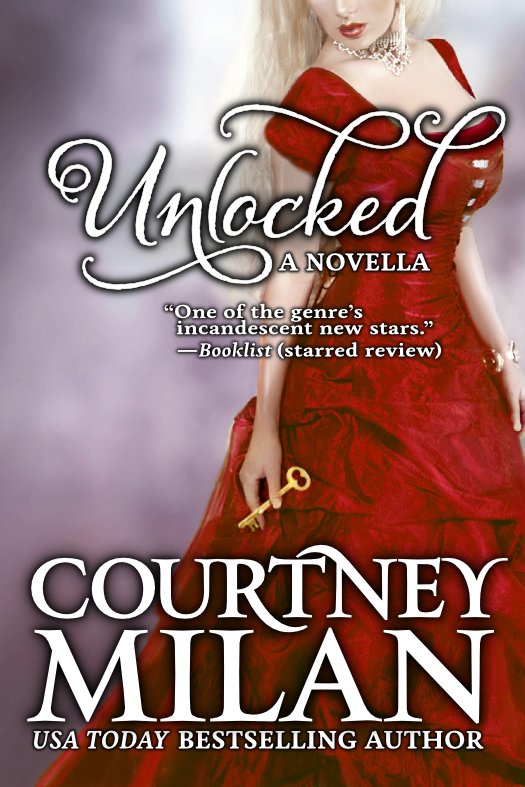
Unlocked Cover Yes, Unlocked.

You are wondering: What is Unlocked? Well, I know that a lot of people were worried that the wait between Unveiled (Ash’s book) and Unclaimed (Mark’s book) was so long–February of 2011 to October of 2011. And I was with you–I hate having to wait eight months between releases.

So I decided to offer you a helping hand. Unlocked is a novella. It’s about as long as This Wicked Gift (for those who read that)–28,000 words, about 111 pages total. It’s set in the broad world of the Turners, but it stands alone. You don’t have to have read Unveiled to read it, and if you don’t read it, you won’t notice when you read Unveiled and Unclaimed.

It’s about Lady Elaine Warren, a minor character in Unveiled, and one who I wanted to have her own story and resolution.

Here’s the official blurb:

A perpetual wallflower destined for spinsterhood, Lady Elaine Warren is resigned to her position in society. So when Evan Carlton, the powerful, popular Earl of Westfeld, singles her out upon his return to England, she knows what it means. Her former tormenter is up to his old tricks, and she’s his intended victim. This time, though, the earl is going to discover that wallflowers can fight back.

Evan has come to regret his cruel, callow past. At first, he only wants to make up for past wrongs. But when Elaine throws his initial apology in his face, he finds himself wanting more. And this time, what torments him might be love…

You can get it from Amazon, All Romance eBooks, and Goodreads for 99 cents ($1 at Goodreads–they won’t allow charges under $1.) Eventually, it will be available at Barnes & Noble, Apple, Smashwords, kobo, and everywhere else I can get it; some of the other venues will take a little more time. (In particular, Barnes & Noble put my account in review, told me that they sent me an e-mail explaining why, and hasn’t yet answered the e-mail I sent saying I’d never got the e-mail. Grr.)

You can get just about any format you want for your device of choice at All Romance eBooks, though, and for the remainder of today they’re offering a 50% rebate on everything in their store–that means you can get Unlocked for effectively 50 cents.

Read an excerpt here, and enjoy!

In any event, there’s more to this story than a 99 cent novella to tide you over between books. I’ll get to that.

Tomorrow.

No, no, and no

Friday, May 13th, 2011

The latest news from the publishing front is that some agents are starting publishing arms.

In case you wonder how this will operate, some of the details are here. Here’s the crucial line:

[N]et receipts will be divided on a 50/50 basis between author and agency, once production costs have been recouped out of the first receipts.

Yikes. If you’re an author or an aspiring author, and your agent offers you these or similar terms, do not pass go, do not do anything else. Go directly to your computer and type up a certified letter firing your agent and put it in the mail. Immediately.

There are two reasons why this is egregiously, stunningly, awfully bad.

First, it sets up an extraordinary conflict of interest for the agent.

Let me illustrate. Imagine an agent lands a traditional publishing deal for his client–$10,000 for a first book. Yay!

Now, you also think that the client can self-publish, and after expenses, and taking into account the time-value of money, the agent estimates they’ll make $8,000 over the lifetime of the book. (Don’t ask me how they estimate that.) Yay! Options!

How should the agent advise the client?

The traditional publisher will make the agent $1,500 and the client $8,500. Under the Ed Victor model, if the client self-publishes, the agent will make $4,000 and the client will make $4,000.

In order to properly serve the interests of the client, the Ed Victors of the world would have to advise the client to take the traditional publishing deal. But this model just skewed the take so that the agent has every financial incentive to give the client bad advice. It gives the agent a $2,500 financial incentive to lie to the client and overestimate the value of self-publishing. More importantly, it gives the agent a $2,500 financial incentive to lie to himself about the value of self-publishing.

At the point when the agent’s interests stop aligning with the client’s, the client can no longer trust the agent to tell the truth. Once that happens, the agency relationship has been irreparably broken.

The second reason this is an instant firing offense is that the terms are unbelievably bad. Ed Victor is talking about starting this with backlist books–books that have already been edited. What is he putting into the equation that is worth 50% of the take? I don’t see it–I really just don’t see more than a few hours of work on his part. He calls someone who scans books. He calls a proofer. He calls a formatter. He calls a cover artist. He pays maybe $800 total for those services–which payment is relatively risk free to him, because the production expenses repay him first. For about 30 minutes of phone calls and 30 minutes of responding to e-mails, he’s taking  50% after expenses are paid. The only way I can understand why anyone would agree to this is because to an uneducated author, it looks better than the 92% that the publisher would take.

Agents who take a 50% cut because their authors aren’t educated as to the alternatives are not acting in their clients’ best interest. On the contrary: they’re declaring themselves to be shysters to the entire world.

There is really only one way to deal with this sort of thing: fire the agent. Now. Even if he didn’t make the proposal to you, if your agent announces this skewed a business model, go to your computer, fire up your word processor, and fire them that same day. Period.

I think there can be a productive, valuable role for agents, even in the self-publishing world. I’m still thinking about what that is, but I think it can exist. But this is definitely not it.

Business Model versus Religion

Monday, March 21st, 2011

Both traditional publishing and self publishing have their adherents, and the battle lines are being drawn.

So, how come there are battle lines?

If someone wants to self-publish, go ahead! If someone wants to sign a contract with their traditional publisher, go ahead! I may care about the outcomes for my friends, because I care about my friends, but it’s hard for me to get worked up because some dude I don’t know just signed a contract for books that will come out in 2014. It’s his choice. So maybe he doesn’t make as much money. I generally don’t get exercised about unknown people who make business choices that only impact their personal lives. That’s because I think of writing as a business, something that I should approach rationally, with reasonable questions in mind, not as a religion that should be taken on faith and not doubted.

Here’s a little test you can run so that you can differentiate between a business model and a religion.

  • Do you think that everyone should do it your way?
  • Do you think that everyone that disagrees with you simply doesn’t understand what you know so well?
  • Do you use words to describe people who disagree with you that are derogatory in nature?
  • Do you secretly (or not so secretly) think that everyone doing it differently is misguided and just needs to come to the light?

Congratulations! You are espousing a religion.

  • Do you think that profit and loss depend on individual circumstances?
  • Can you list circumstances that make profit more likely?
  • Do you accept that, even under the best of circumstances, loss might still occur?
  • Do you believe that reasonable people might differ, and that different ways of doing things might still both prove profitable?

Congratulations! You probably have a business model.

Please note that there are business model/religion types on both sides of the self/traditional publishing divide. There is nothing wrong with having a religion, or holding strong beliefs. Just try to recognize that, as with all religions, someone else holds different beliefs dear, and there’s no need to vilify them for it.

In which competition fails to be perfect

Sunday, March 20th, 2011

This is the vaguely economic argument that people make when they talk about e-book pricing: “The price of all books will go to zero. Everyone knows that in a perfectly competitive marketplace, the price will tend towards the marginal cost of distribution, which for digital goods is zero. Authors must band together and make sure that books are priced at something high, or we will all surely perish.”

I bristle at the indiscriminate application of economics, where nobody checks that the assumptions underlying the economic theory holds true first. Here’s the challenge: if someone wanted to read for free for the rest of their life, they could do it, easily, today. They’d start with Project Gutenberg. There is a ton of Pride and Prejudice fanfiction–more than any one person could read in her lifetime. People have been posting stories–entire novels worth–on livejournals for lo these many years. There is more free reading material available than any reasonable person could tackle. And yet–shockingly–people pay for electronic books.

How can you explain this? Is it a breakdown in the market? Is it that the market has not yet reached equilibrium? Is it that ereaders haven’t yet become commonplace? None of that. It’s because a book is not a perfectly competitive marketplace.

It would be if there were no intellectual property laws–anyone could compete perfectly with books by Courtney Milan simply by making a copy of my book, which would cost them basically nothing to do. Nobody could charge anything for books by Courtney, because somebody would always undercut them. I would make no money. You can see this principle at work on Amazon if you search for public domain works.

Luckily for me I have an exclusive right to distribute my books and to license others to do so, and so there is not a perfectly competitive marketplace for books by Courtney Milan. In fact, the market is quite the opposite of competitive: I have been granted a legal monopoly over books by Courtney Milan, and that means I can charge whatever I want, and nobody else can sell my books for less, unless I give them the right to do so. Therefore, we don’t have perfect competition.

“But Courtney,” you say, “books are economic substitutes for each other. If you charged $5,000 for a book, people would just go and read Sherry Thomas and Tessa Dare and Julie Anne Long and Meredith Duran instead.”

Too true. I may have a legal monopoly over books by Courtney, but there are decent economic substitutes for books by Courtney. The problem is that (a) there are a small number of really good economic substitutes and (b) all substitutes are imperfect, with some substitutes being more imperfect than others.

For instance, I have a vast amount of empirical data demonstrating that at least some people would rather pay $7.99 to read my book than spend $0.00 to read Moby Dick for free. This is because Moby Dick is a really, really bad economic substitute for a historical romance. I like to think that even in historical romance, there is no perfect substitute for a book by Courtney. Heck, my books aren’t perfect substitutes for each other. Most people don’t read Unveiled a second time and say, “Well, now I feel just as good as if I’d read Unclaimed, so why bother?”

We all know that books are imperfect substitutes for each other because if there were, by golly, I still wouldn’t be waiting (semi-patiently) for George R.R. Martin’s Dance with Dragons. I’d have read Coraline by Neil Gaiman and I wouldn’t bother. If books were interchangeable, I wouldn’t have stood in line to get Patrick Rothfuss’s signature. Scheherazade would never have lasted a thousand Arabian nights, because the King wouldn’t have cared how the story ended.

Now, I don’t deny that books are imperfect substitutes for each other. And I don’t deny that this results in  price competition. But as a general rule, the better the author, the harder it is to find a good old-fashioned economic substitute for her Conversely, the worse the author, the easier it is to substitute. It’s really easy to bore people. It’s hard to entertain them. And the authors who can make you laugh consistently–or keep you on the edge of your seat–or have you reaching for your hankie–you know they are not interchangeable.

So, when someone says that price must tend towards the marginal cost of distribution, you are implicitly saying that authors write indistinguishable crap. And frankly, if I believed I wrote indistinguishable crap, I wouldn’t bother writing.

One of the reasons that competition is so imperfect in the book world is that this is a field that is very hard to enter. Oh, you might think it’s easy–all you have to do is slap words down and put a book up on a Kindle. But it is hard to write a book, and it is a thousand times harder to write a good book. It takes a lot of skill and a lot of talent. Self-publishing doesn’t make it any easier to write a good book–it just makes it easier to take a bad book to market.

Writing a book is so hard that there are not enough truly awesome authors in this world to keep the voracious readers in excellent books for all their reading hours. Voracious readers have to settle for “really good” authors and “enjoyable” books. If they read fast and often enough, they’ll delve into the “okay” territory just so they have something to read.

So yeah, I’m not worried about author compensation. It is already the case that authors like Stephen King can charge $34.99 for a book, while authors like Courtney Milan charge $7.99. There’s a reason for that, folks, and it’s because Courtney Milan is a really, really poor economic substitute for Stephen King.

I do think there are some ramifications to the e-revolution. I do think that there’s unmet demand for more reasonably-priced works. And I do think that price-competition will force the price of many books down. But I don’t think that having 500,000 books on Amazon priced at $0.99 will so transform the book industry that everyone will have to drop their prices to $0.99 and will still only sell 100 copies. The book industry has managed to survive against a backdrop where every single excellent book from a century ago is available for free.

The forthcoming apocalypse

Saturday, March 19th, 2011

There are rumblings around publishing blogs about the forthcoming apocalypse. What apocalypse, you ask? You know–the apocalypse in which all of New York publishing crumbles to dust under the onslaught of a vast supply of 99 cent books, which force the market price of a book to that of an iTunes download. That apocalypse.

Everyone seems to be making a bunch of predictions about what will happen, and I figure that I’m about as qualified to prognosticate as anyone else out there. I am confident that every single one of these little gems will come true in the following five years, so read ‘em and weep.

  1. A lot of people are going to make a lot of claims using figures that were gleaned through confirmation bias. The word “data” will be used when the person means “anecdote.” Multiple anecdotes will be strung together and pointed to as “data,” and statisticians will weep and gnash their teeth and talk about the need for random sampling to no avail.
  2. Really good books will be published, which makes me happy as a reader. Some of those books will have a low, low price, which will make me happy as a consumer.
  3. Crappy books will also be published, priced anywhere from $400 to $0.99. Hopefully I will avoid most of them.
  4. Really good books at a reasonable price will always be in demand.
  5. There will not be enough really good books available to satisfy the most voracious and/or picky of readers.
  6. Thus: reasonably good books will also be in demand.
  7. Crappy books will not be in significant demand at any price.
  8. Some really good books will still have disappointing sales, and fans will be baffled.
  9. Not all really good books will come from New York.
  10. Not all crappy books will come from indies.
  11. People won’t agree on whether a book is really good, but if everyone agrees that a book is crap, it probably is.

If 99 cent books were going to destroy the nascent ebook industry, I would think that Project Gutenberg would have done it by already. There’s a massive number of REALLY GOOD books available for free–and yet people still buy the latest Stieg Larssen. People buy the latest Courtney Milan, for that matter, too.


Courtney Milan’s Blog is proudly powered by WordPress
entries (RSS) and comments (RSS).
content © Courtney Milan, 2006-2009
author photo © Jovanka Novakovic | bauwerks.com
cover copyright © 2010 harlequin enterprises limited
cover art used by arrangement with harlequin enterprises limited. all rights reserved.
® and ™ are trademarks of harlequin enterprises limited and/or its affiliated companies, used under license
home \"home books \"books about \"about contact \"contact faqs \"faq articles \"articles