Translations in the Anthropic Book Settlement
I have probably seen more people talking about complicated issues with multiple authors surrounding translations than anything else.
This is a copyright explainer that will help you understand how to look up exactly what the work in question is in the Anthropic lawsuit, what rights you hold (and do not hold) in a work, and what language to use to explain what is happening and who does and doesn't have rights to someone who is legally trained, like hopefully someone in the settlement administration or (if it comes to that) the special master.
First: the work in question. For every work in your allocation portal, you'll see some information. It will look something like this.

That number--the one that starts TX something--is the copyright registration number of the exact work in the Works List that was found to be downloaded.
In my case, it's TX0008061103--the Spanish language version of a book by me, Courtney Milan, called The Suffragette Scandal in English.
You should look this exact work number up in the copyright database, which you can find at publicrecords.copyright.gov.
If you do, you will get a copy of the copyright record. If you use the number I described above, you'll get something that looks like this.
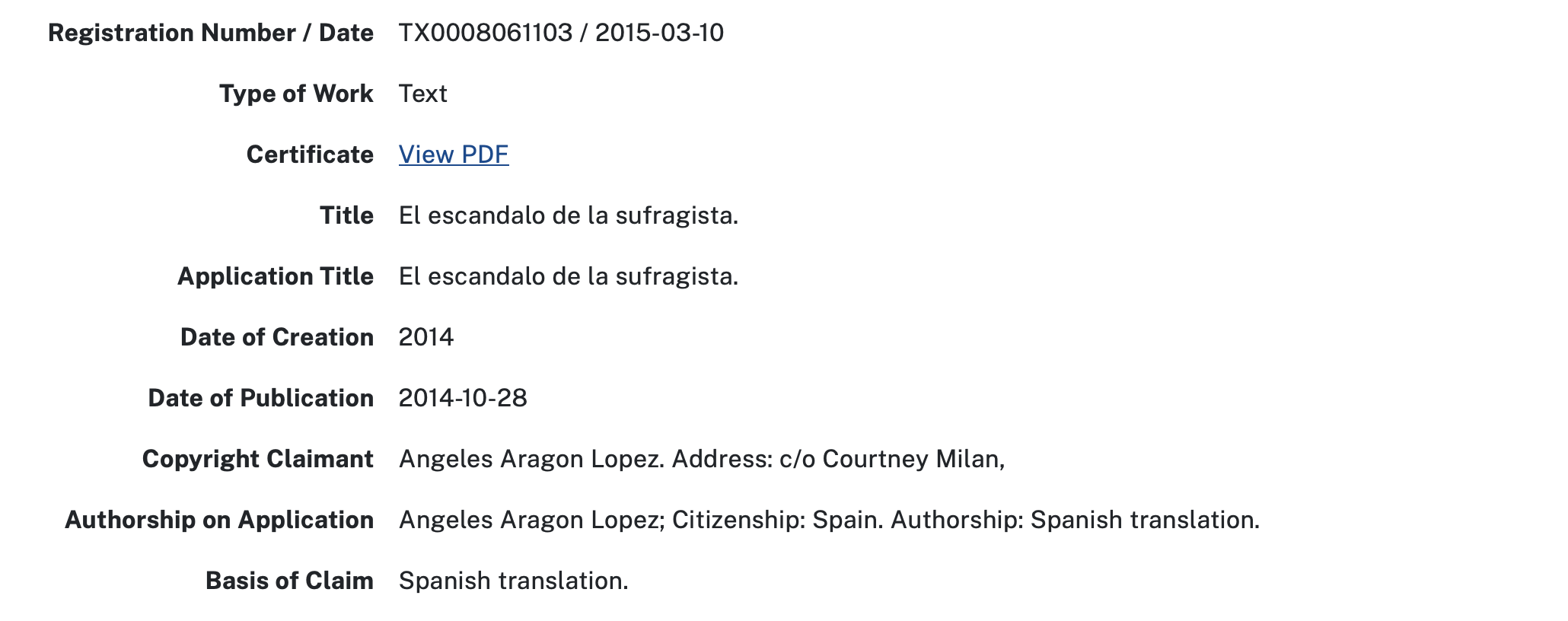
First, while we're here, click on "View PDF" to get the copyright certificate and then save that. You'll need that later on.
Second, you may notice something surprising here.
The Authorship on Application is listed as "Angeles Aragon Lopez." That is the translator of this work.
Courtney Milan is not the author of this work.
So here is something you need to know about language and legal usage in order to explain what is happening.
A book has an author. We are going to call that person the Original Book Author.
A translation of a book is its own copyrighted work. The Copyright Author of the translation is the translator; we are going to call that person the Translation Author.
The Original Book Author is not generally the author of the translation, unless the Book Author did the translation themselves. (There also may be work-for-hire situations that mean the Copyright Author is not the Copyright Claimant.)
So what is the Original Book Author to the translated work?
The Original Book Author is usually legally a beneficial owner of a translated work: that is, the Original Book Author is generally entitled to royalties on the translated version of their work.
So how does this all shake out?
In the example I gave above, there is, on the author side of the equation:
- A Translation Author (Angeles)
- A beneficial owner (me)
So assuming we have agreed to a default split, we would split royalties on the author side 25% to her, 25% to me. Then 50% to the publisher.
(In this case, not that it's purely relevant, since this is a self-published work in translation, we're splitting 50/50 because I think foreign translators have gotten screwed enough by this already.)
So that's the basic case. The reality I have seen can be much more complicated. I have seen people who have four translators claiming on their English language works, or conversely, a translation into English that is getting people making claims from anywhere and everywhere.
Luckily, all these things can be settled with the method I described above.
Let me give you a few hypothetical examples so you can see how to talk & write about this.
Hypo #1: An English language work with multiple translations
Let's take a hypothetical book #1, called "Data Centers: Fuck this AI Shit" by Ren Away. This book has been very popular, and has been translated into fourteen languages; the translators for all of those languages, plus the original author, have all put claims in the Anthropic settlement.
Who gets a share, and how much?
Step 1: Find the copyright registration number.
(Let's say it's TXBUNCHANUMBERS)
Step 2: Look at the copyright registration number and see what exact work is being claimed.
In this hypothetical case, let's say that the authorship and the copyright claimant in this exact work is listed as Ren Away.
Step 3: Download the copyright certificate.
Step 4: Write a narrative explaining the authorship in this exact work, and the authorship that the other claimants have.
That would look something like this:
The exact work at issue here is TXBUNCHANUMBERS. I have included the copyright certificate for this work. As the certificate shows, the work that was infringed is the English language work, and the sole author for this work is myself, Ren Away.
Claimants 2-14 appear to be translators of foreign editions of "Data Centers: Fuck this AI shit." While they are authors of those translations, those translations are different works than the one at issue here. For that reason, Claimants 2-14 are not entitled to a share in this work.
Hypothetical #2: A german translation of an English work for which there are multiple claims
The work in question is "Datazentrum: AI ist Scheisse," a translation of the above work by Ren Away, translated by Max Pain, copyright registration TXDIFFERENTNUMBERS.
Who gets a share, and how much?
Step one: look up the copyright registration.
Step two: look at the authorship. In this case, it will likely say that the author is Max Pain.
Step three: download the copyright certificate.
Step four: write a narrative of copyright ownership.
That might look like this:
The exact work at issue here is TXDIFFERENTNUMBERS. I have included the copyright certificate for this work.
As the certificate shows, the work that was infringed is "Datazentrum: AI ist Scheisse." The translation author is Max Pain. This is the German language translation of "Data Centers: AI is shit," and the author of the original work is Ren Away. Ren Away is a beneficial owner in Dataxentrum: AI ist Scheisse because Ren Away receives royalties on the work (see attached German language contract).
Claimants 3-14 appear to be translators of other foreign editions of "Data Centers: Fuck this AI shit." While they are authors of those translations, those translations are different works than the one at issue here. For that reason, Claimants 3-14 are not entitled to a share in this work.
The author portion of this work should be split between Max Pain (the translation's copyright author) and Ren Away (the beneficial owner and author of the original work).
Courtney's notes on this hypo: It is extremely unlikely that we'll see a large number of foreign translations on the Works list, simply because foreign publishers are less likely to get a US copyright. Exceptions may exist for works that have significant demand in the US or publishers that did it for other reasons. However, I know they exist, since I have one.
You might ask what the legal basis is for a split of the author portion between translation copyright owner and original owner. I don't actually have one. There usually won't be a contract between the translator and the book author, and while you could make arguments that they should get a proportional share of their royalty split, you actually are very unlikely to have any idea what their royalty is.
So you could try and pick nits without reference to a contract to pick them from, or you could just throw up your hands and not act like a multinational corporation trying to get every last dollar that you possibly can, and just say "screw you AI, me and my translator are both literary artists and we're going to split this evenly because we stand in solidarity with each other."
At least that's what I would do. But that's a moral standpoint, not a legal one, and your thoughts and situation may differ from mine.
Hypothetical #3: Foreign language work translated in to English
The work in question is "I love art!" an English translation of the original German language book "Ich liebe Kunst!" written by Wolfgang Meissner. The English translator is Johnny Giraffe. Registration number is TXSTILLMORENUMBERS.
Step one: Look up the copyright registration. You're getting used to this, right?
Step two: Look at the authorship. In this case, the copyright author is likely to be Johnny Giraffe, the English translator.
Step three: Download the certificate.
Step four: Write a narrative.
Copyright registration for this work, TXSTILLMORENUMBERS, is a copyright registration for "I love art!" which is an English translation of "Ich liebe Kunst!" by Wolfgang Meissner. The copyright author in this translation is Johnny Giraffe. Wolfgang Meissner, the original book author, is a beneficial owner.
For that reason, the author portion of this work should be split equally between Wolfgang Meissner and Johnny Giraffe.
Please note that translations may raise some weird questions not fully addressed by these hypos.
For instance, Emily Wilson is the author of her translation of Homer's Odyssey, but we're not splitting her author share with Homer because the original work is public domain. Claiming something is public domain--particularly when it impinges on the law of another country--is tricky, but for authors sufficiently dead, it's pretty easy to say something like "Homer died in 701 BC."
Also additionally: what do you do when, say, the original work was written by two co-authors, but the translation is done by a single translator?
Again, this is not a legal judgment, because if you wanted to make the special master's life absolutely miserable you'd make them evaluate every single foreign rights contract and figure out what a split might look like from principles that nobody considered when drafting the contract, but my sense would be to treat the co-authors as beneficial owners who each get 1/2 what a full beneficial owner would get, and to treat the translation author as a full author.
That would make the split:
50% publisher
25% translation author
12.5% original co-author
12.5% other original co-author
Some additional questions you might have
Why does the beneficial owner get anything? Why isn't it all the author?
I've seen people ask (or assert) things to this effect and look......
Okay I'm not gonna explain it, except to say that if someone has a right to profit from a thing and somebody steals that thing, they have a right to share in the recovery that you get from that theft.
This is a pretty well-established legal principle and you can argue otherwise but you will lose.
What do I do if a lot of publishers are claiming this work?
If the actual work is self-published, or the rights have reverted (e.g., you are the sole owner in an English language work) and foreign language publishers are claiming a percent, they get zero, and please go away.
If the work has a publisher, and three publishers are claiming it... you know what? That's not your problem to work out. Assert that the publisher percentage is 50%, and let them fight for who gets it.