Frequently Asked Questions
In 2013, I said I would take some questions on my Tumblr account. These questions are preserved here. As of 2020, I've glanced over these while copying them to a new website and have determined that I gave a lot more fucks about civility in 2013 than I would in subsequent years. In a few instances, I've marked a few points where I'd say something different below; I've edited others for various reasons.
The questions are split into three groups:
Questions About Me
Questions About My Writing
Questions About My Books


Questions About Me
Q. Did you always want to be a writer?
A. Well, yes. And no. Between the ages of 5 and 18 I wanted to be an author. I wrote my first book when I was ten. It was called TO BRING BACK THE BUFFALO, and the plot was, the buffalo (a) were inexplicably missing, and (b), even more inexplicably, could be brought back by a ten-year-old girl entering a cave and solving magical puzzles akin to alchemical hopscotch.
After I graduated from high school, I tried to be an author for about six awful months of college. I failed, and decided I just wasn’t creative enough to be a writer. So I gave up and did science instead. I programmed computers. I took courses (plural) in quantum mechanics. And when I got bored of quantum mechanics I went and did more analytical stuff. After all, I knew I wasn’t creative, and so I might as well become a hard-bitten analytical type.
I wasn’t bad at being a hard-bitten analytical type, but after about… oh, you know, several decades of it, I thought I should give this writing stuff a try again. So I did.
Q. You spent a lot of time getting your law degree, so what is it about writing fiction that called to you? Also, why do so many lawyers seem to be leaving the profession to become writers?
A. That makes me sound much more together than I actually am. My actual career path looks like this:
1. Go to school. Plan to major in history/sociology/anything except math, because I wasn’t good at math.
2. Realize I was wrong. Decide to major in math.
3. Add on a major in chemistry, just because.
4. Go to grad school for chemistry.
5. Realize I don’t want any of the jobs I can get with a chemistry PhD; leave with a masters.
6. Go to law school.
7. Work for some judges.
8. Realize that, because I have occasional bouts of depression that leave me completely unable to function, that actually practicing law would be malpractice—I’d be sure to miss an important client deadline at some point.
9. Decide to become a law professor.
10. Realize that people criticize law professors for lots of reasons, including that they talk about intellectual property but don’t really own any.
11. Think, well, why not see if they’re right?
12. Discover that writing fiction that thousands and thousands of people will read is a lot more fun than writing law review articles that ten people (most of them law review editors) will read. Other important benefits: I make money that doesn’t come from people taking out egregious student loans.
13. Eventually I quit being a law professor, and now I write books.
This list contains numerous vast over-simplifications, but I have spent a lot of time doing a lot of things. I think this is a feature, not a bug. All of those things inform my fiction writing to some degree or another.
I can’t speak for any particular person, but yes, there are a lot of refugee lawyers in writing. There are a lot of refugee lawyers EVERYWHERE, actually. This is because the practice of law pretty much sucks. Some people do like it; a lot merely get through. Law is one of the few professions where the response to “I got a job!” and “I quit my job!” is “OMG! Yay! Congratulations!”
(ETA 2020: I didn't mention above that one of the reasons I quit law and was depressed was the sexual harassment. I wasn't talking about it at the time.)
Q. This isn’t a question, but the way you managed to work in the Rule Against Perpetuities in The Heiress Effect made me a) laugh out loud on the subway, much to the consternation of everyone in the car, b) made every other law person I know laugh when I told them about it, and c) made me feel like the weeks spent 1L year trying to wrap my head around that STUPID GODDAMN RULE WHY GOD WHY a tiny bit worth it.
A. Is it awful that I actually REALLY ENJOYED learning the Rule Against Perpetuities? God, property law was sooo much fun. It was a massive game with rules that made almost zero sense. It was like playing a really messed-up version of chutes and ladders and if you went the wrong way you’d end up sliding back to the very beginning.
It was like my topology class: completely messed up.
Except, unlike topology, this happened to real people.
That part of the book was also my way of making fun of myself, because the part of me that is such a law professor (and I am everything that is wrong about law professors embodied) just LOVED the Rule Against Perpetuities, and it’s completely useless as a teaching tool. (I never taught property though.)
The fact that people who ADORE learning the RAP end up law professors is why none of us can have nice things.
Q. How has your answer to "Who are some authors that inspire you?" changed (if it has) since you began?
A. I don’t even know if I have an answer to that anymore.
I have a lot of friends in the writing business, and they help keep me sane. When I need to whine to someone about a plot point not working, or I’m upset about something, I have people to talk to and that helps a lot. But it’s not an inspirational level kind of thing any longer.
I suppose I could pick authors who I aspire to be like, but at this point, I’m realizing that there are so many ways and so many strategies to being a successful author that my best choice is to figure out the best version of me as an author and stick with that. I’ve made myself miserable trying to do things that other authors do that don’t feel natural to me, and I’ve finally given myself permission to not aspire to be anyone else.
Nobody else is the same author I am, and that means that the person I most aspire to be is me.
That’s the biggest change—I’ve learned to trust that I’ll make good decisions about my writing, my books, and my career. I didn’t have that trust in myself when I was a newer author.
There are a ton of other authors I respect, love, and who I learn from. Every other person out there has something they can teach me, if I’m willing to learn and filter out the things that don’t feel natural to me.
If I made a list I’d leave people off and then feel tremendously guilty when I remembered and I’d go back and eventually it would be a list of basically the entire world, so I’m going to not do that now.
Q. Have you considered investing in cloning so we can get even more books from you?
A. No. It wouldn’t work that way. I do not work well with others. I don’t even work well with me when there’s just one of me.
Q. What are you favorite and least favorite parts of the type of publishing that you do?
A. Favorite parts: I like many parts of the writing process. I like writing when I know how things are going to go. I like writing when I don’t know how things are going to go but suddenly I have an idea while I’m writing and it’s much better than anything else I could have had any other way. I like editing and making something that doesn’t work work. There’s nothing better than taking a clunky, painful scene and turning it into something that sings.
I also really like being my own publisher. I like nobody else having control over my books. I like being able to make choices, and to revise whether they’re working or not.
I like thinking strategically. I like coming up with new projects, especially if they’re fun and cool and other people haven’t done them before, or if I have a new way to do them.
I also really like (as part of being my own publisher) that I can work with people and decide how much they get paid—and that means I can pay them a living wage in exchange for the work that they do, which isn’t always true for traditional publishers. Most editors for traditional publishers start off as baby interns, getting paid somewhere between zero and maybe under $20K a year, and you cannot live in NY on that amount of money unless someone else is subsidizing you. What this means is that there are a lot of voices that simply don’t become part of this system.
I have specific people I work with in mind as I say this, but since I don’t have their permission to share individually, let me just say that if you think that New York publishing is paying its marketing interns, its editors, its copy editors, and its proofreaders fairly, you are not paying attention. Some people do come out okay—I don’t want to argue that—but New York publishing really doesn’t pay well as career choices go, and if you think that that doesn’t hurt diversity, it definitely does. On balance, if you believe that a massive corporation is going to do a better job of paying a living wage than you, as as a committed individual, will? No.
So I like that I can choose to pay the people who help make my books better a fair amount for the work that they do, and I don’t have to worry about whether someone’s getting bottom-basement prices.
Least favorite parts: Anything that involves repetition. I like coming up with new projects but I am terrible on completion and follow through. (In part this is why I hired an employee—so that I could take all my best ideas and then have someone else follow through.)
There are also times when I get stuck writing, or don’t know how to fix something, and those can be painful.
But mostly, there aren’t a lot of painful things, and I’m really lucky and privileged to be able to do this for a living.
Q. Were any books you read particularly meaningful to you as a person of in your desire to become an author?
A. Oh, there have been hundreds.
If there hadn’t been books that were meaningful to me as a person, I would never be an author. Books have always been my best friends—always. I could start listing them, but there are seriously so many of them that it’s just impossible for me to do that.
The books that drove me to be an author, though—the ones that specifically made me say “I can do this”? Happened to be the books that pissed me off. They’re the ones where I got enraged and stabby and annoyed, because of something that set me off, and made me think, “Well, if I were going to write a book, I would…”
That’s pretty much the story of how I decided to write books. I was driven to it by rage.
Q. Do you ever struggle against the label of romance novels being fluff, i.e. not “real” literature?
A. No. I mean, I could, but it wouldn’t make any difference, so I don’t bother.
Q. How do you feel about fan art of for your books?
A. I am a fan of all things fannish.
Go for it!
Q. Off the top of your head, what strikes you as the most ridiculous (as in funny) law?
A. I don’t really have a good memory for trivia laws from 1864 about chewing gum (and half of those are apocryphal anyway), so I wish I could answer in that way, but I can’t.
And for laws on the books right now, it’s really hard for me to pick one as “funny” because they may be ridiculous, but they happen to people, and when they happen to people, it’s the opposite of funny.
Every “funny” law that is technically on the books is an excuse that someone can use to punish someone who is outside the norms.
Q. Your books could be described as feminist fairytales because they read as parables of various feminist tenets (e.g. Unveiled as consent, Unclaimed as slut-shaing, etc.). Can you talk more about your relationship with feminism, in theory and/or in practice?
A. My parents are actually vvveeeeerrrryyyy conservative. I was raised in an extremely strict religion, and my parents were actually even stricter than the religion required. They signed that form that made me sit out the sex education classes in the library because they didn’t want me to learn about birth control. We didn’t have a television until I was 10 years old (and I’m the 6th of 7 kids—so this pretty much means that many of my elder siblings never watched TV at all at home) because they didn’t want to expose their kids to Bad Things, and even once we got one, my mom banned us from watching most shows. She objected to Duck Tales (the cartoon) because the intro music had a rock music type beat, and so watching Duck Tales would lead to listening to rock which would lead to… I don’t know, teenage pregnancy?
(Parenthetical aside: To my parents’ credit, they also raised me to question and be curious. When I started asking uncomfortable questions at church, and the people in charge of adolescents went to my dad and said, “Control your daughter,” he said, “Why can’t you answer her questions? Questions aren’t dangerous. Your lack of answers is dangerous.” And then he told me that I could ask all the questions I wanted, and that he’d rather have me think consciously about the path I chose than walk blindly after him. And the same mother who complained about rock music intros to cartoons read me Alex Haley’s Roots as a bedtime story when I was six, which was…not really age appropriate, among other things? So it wasn’t a totally sheltered childhood.)
It took me a really, really long time to get to the point where I said, “you know, screw this.” The process of saying “screw this” took a really, really long time. I’m still going through it. It means dismantling and taking apart and questioning things you have believed—and that people you love still ardently believe—all your life.
In any event, the point of this is that the themes that come out in my books are not really feminist by design. The themes that come out are things that are personally important to me, and a lot of those themes, for me, happen to be feminist in nature.
Feminism is something I had to learn on a deep level in order to be happy and love myself, and inevitably, this struggle shows up in my books.
Q. Has Mr. Milan reviewed any of your books since the Carhart series?
A. Mr. Milan was not gainfully employed when the books in the Carhart series came out, and that meant he had a lot of time on his hands. That is no longer true.
Also, he said he had run out of stereotypically-dude-like things to say and the joke had run its course. (He’s not quite as in favor of Sherman Tanks as the reviews made him sound.)
Q. Do you have any favorite characters? Do you have any favorite story motifs, like friends to lovers, rake and bluestocking, Cinderella, arranged marriage, etc.? Do you find that any of your stories or characters are particular fan favorites?
A. Girl dresses as boy. I will read anything with that premise, and when it works well it works deliciously and I will read and reread and reread it a bazillion times forever and ever.
For some reason, though, I have a hard time actually writing that. I wish I understood why.
My own favorite characters are always the difficult ones. I love Smite. I love Violet. Difficulty, thorny characters who are hard to get to know really get me.
As for fan favorites, every single book I have written has people saying that X character from that book is a favorite, and other people saying that X character from that book sucks and is totally unlikeable. If I picked a fan favorite, a thousand people would write to me and say, “BUT NO NOT HIM!”
Q. Out of all the books you’ve written, which is your favorite? In what terms and why?
A. The two that are closest to my heart are The Countess Conspiracy and Unraveled, mostly because they touch on personal experiences that have really shaped who I am today.
But everyone has their own favorites for a variety of reasons, and my favorites aren’t as important as your favorites.
Q. Can you tell us more about your cat and your dog, Pele? How old they are, breeds, how they came into your life, etc? Also, do you think you will ever have a pet or animal feature prominently in one of your books (like Smite’s dog Ghost in the Turner series)?
A. This is Silver. He’s my cat.
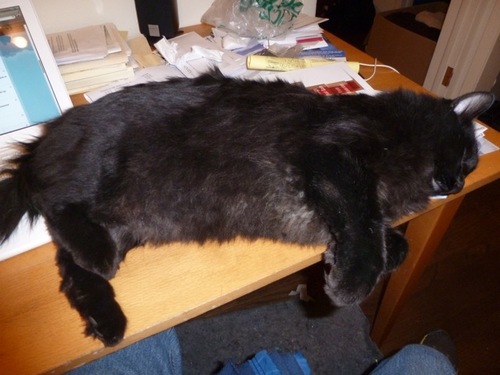
He is large and black and has medium length fur, which is all we know about him.
We got him because one of my husband’s coworkers was complaining about how much he hated his cat constantly. How awful the cat was. How he wanted nothing to do with the cat. How he got stuck with the cat because of a divorce and it was really his kid’s cat and the wife’s new husband was allergic.
In any event, at some point, the guy went on vacation and asked my husband to watch the cat.
And then the dude (who I don’t think too highly of) never took the cat back, which is just as well, because Silver is not awful, terrible, or even remotely hate-worthy.
He’s majestic, and he knows what he wants. What he wants is food, snuggles, and the opportunity to go outside and have a little fun. (He also does not like other cats.) Give him those things, and he is the BEST CAT EVER. Do not allow him to have those things and he rains terror down on you.
This is Pele, my dog.
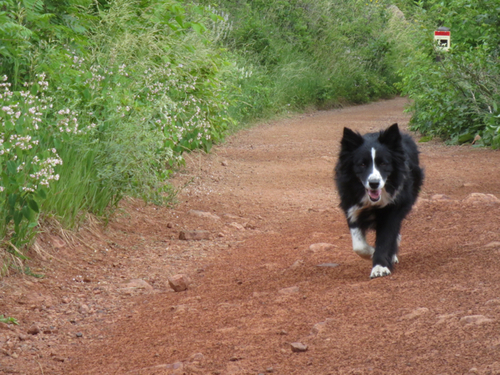
He’s an Australian Shepherd—actually, he’s part mini in ancestry.
We got him because I wanted a dog. I really wanted a dog. When I was in grad school I couldn’t have a dog because there were no pets allowed in my apartment. When I went to law school, I couldn’t have a dog because there were no pets allowed. When I was clerking for judges, I had no time, so no dog.
So when I was getting to the end of my clerkship, I told my (not yet husband) that I wanted a dog, and he balked. He said things like, “still living in an apartment” and “dog is a lot of work” and I kind of flipped my lid and threw a temper tantrum. I believe there was foot-stamping involved. I may have uttered the words, “I want a dog, and I want a DOG NOW.”
It was not my finest moment, but I had been waiting to have a dog for SO MANY YEARS.
In any event, he said “I see that having a dog is important to you, so I suppose we can get a dog.”
The next day I e-mailed him pictures of the puppies where I’d put a deposit on the litter, which he found mildly surprising, as it had happened very quickly, but I pointed out that given that I had said that I wanted a dog NOW, waiting until the day after was pretty good.
I picked a breeder who bred working dogs as well as show dogs—this was very important to me, because they’ll care about not just what features the dogs have, but they’ll really care about dog health and temperament. One of Pele’s brothers is working on a cattle farm, in fact!
Pele is the smartest, sweetest, snuggliest, fastest dog in the world. He needs a lot of exercise, which is good for all of us. He is a champion face licker—one time, when we picked him up after a trip, we timed him, and he licked my face 936 times in just under 10 minutes. He understands practically everything I say.
The creatures really like each other, too—Pele and Silver play together and sleep together.
Here is an EXTREMELY BAD video I put together a few years ago blatantly pimping my creatures out for votes in DA BWAHA (a romance novel tournament) last year, so if you want to see what I mean by “play together” that gives you a good idea.
In short, my creatures are wonderful and I feel very lucky to have them.
Will I have more creatures in my books? Probably, but I have to be careful or they’ll take over EVERYTHING. That’s why you don’t see a lot of them.
Q. Do you look at reviews for your books, both positive and negative (on sites like Amazon, Goodreads, etc.)? Although reviews are for readers, and it’s probably not very pleasant to read the negative ones, perhaps you sometimes get good feedback or ideas from readers by reading them?
A. I do look at reviews. Not all of them. Not always.
Sometimes I specifically want to read negative reviews because it lowers the pressure I’m feeling. (Pressure is the enemy of productivity.)
When I’m working on a book and it feels off and nothing’s working, negative reviews are awesome, because I can read them and say to myself, “YES! Here is one person I will not disappoint with this awful, crappy book!” And then I can give myself permission to go and write awful, crappy things, which is sometimes the only way that you can eventually get to something decent.
Positive reviews can be awful. Someone says, “Wow, everything Courtney writes is amazing! I wish I could read her grocery list!” and I want to curl in a ball and scream, “NOT THIS THING! My grocery list says, ?Fresh out of ideas, stop sucking!’”
I am actually more likely to be in a place where positive reviews are hard for me to take than negative reviews.
It’s my job to figure out where I am mentally and if I’m in a place where looking at reviews is going to cause me problems, I need to not look at reviews.
Why do I look at reviews at all? Curiosity, mostly.
But reviews, positive or negative, are not about getting feedback or ideas. (And if you look, you’ll see that almost everything that one person hates, someone else loves—as an author, I really couldn’t conclude anything from my books except “some people appear to like my books and others do not.”) By the time I’m done with my books, almost everything in there is the result of deliberate choice—that is, even if that element is not perfect, I felt that this was my best choice out of the choices available to me—and I’m unlikely to make different deliberate choices. There are VERY, VERY few instances where I look back at a book and say, “I should have made X choice instead of Y.”
(ETA 2020: I almost entirely avoid reviews now at this point, just because it sends my anxiety into overdrive.)
Questions About My Writing
Q. Why do you write in the time period you write in?
A. I write historical romances set in the interstitial period between the Regency and the Victorian era. Over those few generations, the whole idea of “society” changed. It used to be that people lived for generation after generation, doing the same inherited jobs for generation after generation, moving in the same social circles for generation after generation. Then, the industrial age broke out with a vengeance, and the result was a large number of mobile workers with shallow geographical roots.
For the wealthy, land lost its value as currency. Noble obligation shifted from a system that was almost feudal to the far more laissez-faire capitalism that dominated the nineteenth century. People that understood this profited (at the expense of others); those that clung to the old ways did not. It was a time of tremendous social upheaval, and over the course of a few decades, long-rooted social traditions just disappeared.
There are a number of strong parallels between that time period and the one we live in. The children of today (and I include myself as a child) think that the word “community” includes myspace and twitter, something very different than the world their grandparents knew. I’m not trying to knock either definition; quite the opposite. One of the fundamental human hungers is for community, for a place in society where you fit in and are needed and need others in return. For all that people talk about capitalism and commerce in the news, I think what humans most desire is to give. Humans need to feel like we have something special to give, and we want to receive in return. Love is both the most selfish and the most generous thing in the world.
Romance, in my mind, is ultimately about that hunger. It's about finding the person that grounds you in community. I love writing in a time when the very notion of "community" was in flux, because it means my heroes and heroines can not only be missing love in their lives, but often are missing that vital connection to community. The community they would have fit into twenty years ago has fallen to pieces, and the one they yearn for doesn't yet exist.
So they not only have to grope their way towards love, but they have to invent a place where the future stops being scary.
Despite the carriages and cravats, this is, I think, much like today.
Q. What kind of heroes do you like?
A. In reality, I prefer low-drama people: smart, laid-back, with a great sense of humor. When I decided I wanted to write romance novels, I broached the idea with some trepidation. The conversation went something like this:
Courtney: So I decided to write a romance novel. It’s kind of crazy, because it’s really hard to get published and I don’t really know anything about writing a romance novel and only something like one out of every twenty thousand people who write a book ever publish it and even then they only get paid $3.72 for their efforts—
\Mr. Milan: Yes, but you’re one in a million. You’ll do it.
You see? Mr. Milan is great for the ego, but just awful for fiction. If he were a proper romance novel hero, he would need to react to some odd childhood trauma and flounce off and not talk to me. He would need to make some kind of macho comment to prove his masculinity. Instead, he just made me dinner.
Mr. Milan serves as the inspiration for precisely none of my heroes. In fiction, all my heroes are nothing like Mr. Milan. They react emotionally (even though they would never admit it). They are wounded. They are all trying to do the right thing—but sometimes their past blinds them to the truth, and they need to find that one special woman who lets them see. The only thing my fictional heroes have in common with Mr. Milan, is that at the end of the book, they know the woman they’re with is truly one in a million.
Q. Why do you write historical romances, and not contemporaries?
A. One of the first commandments of writing is, know thyself. I know myself pretty well. I don’t remember movie star names—I can’t even recognize them if I see them on TV. Advertisers gnash their teeth when I see them coming, because I can’t recall a brand name for the life of me. I am completely, blithely ignorant of pop culture. But ask me about the history of the decimalization of English currency, and I will go on and on for hours. Really.
Q. Can you talk a bit about your research process?
A. It’s actually kind of a mish-mash.
There are some things I do for every book. I have a subscription to the British Newspaper Archive, and I try to read the newspapers for the time/place when a book is set, just so I can get an idea of what is happening in the world, where things happen, what kinds of things happen.
I visit the places where I’m planning to set a book. I usually visit the office of tourism, and I buy just about every POD piece of local history that they have in stock. (Waterstones in the UK usually also has some pretty good local resources).
I try to read period fiction, too—Dickens is phenomenal. Because he was paid by the word, he tends to include a lot of detail that is extraneous to the story. It may drive high school students mad but it’s awesome for me. I read a lot of autobiographies. I like trying to see the world from someone else’s point of view. These are not all historical, but that doesn’t make them any less useful.
Now to more specific things.
I do research on specific things: so, for example, in A Kiss for Midwinter, Jonas is a doctor, and so I had to figure out how people became doctors, where he went to school, what was involved in medical school at the time, how doctors operated and were paid, what kind of medical advice they gave, what were the salient issues of the time, and so forth. A lot of that gets done in the very early stages of the book.
This varies from book to book, but usually, when I’ve given my character something to do, I have to ask, “What would she have to do? What would she have to know about? What tools would she have, what experiences would she have? Where must she have been?” And filling out those details takes some time.
Then there are little things that come up: like in The Countess Conspiracy, for instance, I had to try and figure out when people invented bar charts for a casual reference. (I could have just made it a regular graph, but I thought “bar chart” sounded funnier in context than just an XY scatter plot.)
I have a subscription to the OED, copies of the compact edition of the OED and the Oxford Historical thesaurus and the Oxford Historical Name guide.
And then I have a ton of actual books that are useful: books on fashion, books on the plants, birds, and trees that you find in the countryside, books on ships and so forth, books on the running of country estates and farms, books on food, etc, which I reference again and again and again. I probably (at this point) have about 200 research volumes on my shelves.
So that’s basically it!
Q. Have you thought about switching genres and writing contemporaries/PNR/etc?
A. I actually have two chapters written of a paranormal urban fantasy (not a romance), and if I had a little more time I’d probably finish it.
I probably will finish it at some point.
I don’t think I’d ever stop writing historicals, though—I’d just dabble in something else.
[ETA in 2020: yes, obviously.]
Q. Are you ever going to write more science/math ladies?
A. Probably.
Q. When you’re writing a book, which parts are easiest for you to write, and which are the most difficult?
A. I write all the scenes I know about in the book first, and then write a bunch more scenes that writing those scenes made me think about, and then write even more scenes connecting those scenes.
At some point, I have a big mass of unconnected scenes and I have to go through and make them into a coherent book, and that part is really, really time-consuming.
Q. When writing your stories do you listen to music or is it more of a distraction?
A. I do listen to music, but I find it a distraction if it has words, or even if I have not heard it before and it is good and I want to stop writing and listen. But singable music is the worst for me. I can handle music with words if it is bad music (e.g., everything they play at Starbucks) and I tune it out, or if the music is not in a language I understand.
This means I end up listening to a lot of classical music when I write—because my parents played classical music most of the time when I was a child—so it hits that sweet spot of “no words, know it well enough it doesn’t distract me.” (And by classical music, I mean mid-to-late-romantic, not baroque. I don’t like baroque.)
Sometimes I will put one particular piece on continuous repeat and listen to that exclusively for like…a week. Or a month. Depending. Because having the wrong thing come up at that time in the book can be really distracting.
Q. Your protagonists are very differentiated…there’s a great deal of psychological intimacy in each book, and no carbon copy characters in sight. Could you speak to your process of getting to know your characters and particularly getting inside their heads and hearts?
A. I don’t know that I have a good answer to this. The truth is that the first draft of my books are always a disaster because I often have no idea who the people I’m writing are. I mostly use that to figure out what they do. If you read the first drafts of my books, you’d hate them. (And indeed, some people do no matter what, and that’s okay.)
I go through a lot of drafts, looking for things that don’t line up, looking for ways to deepen the characters, figuring out why this person would do this thing.
There is no rhyme or reason. I try out a LOT of different things and some work and some do not, and I hope that by the time I’m done with the book I’m left with the ones that do work. It’s basically a big old pile of mess and a slog, and I spend a lot of time tearing my hair out saying, “WHY? WHY? WHO ARE YOU?”
This may not be a good answer, or a satisfying answer, but it’s a true answer.
Q. Do the ideas rush at you, or do you think, “I’ve done this before” and then strive to make it different?
A. It’s not really that easy. I get lots and lots of ideas all the time, and I can’t shut them up. But one idea is not a book. So I have an idea that’s like, “I know, my heroine is going to have X.” And another idea that’s like, “A woman and a man both want Y.” Eventually, my ideas collide into each other, and once I have enough ideas sticking together, it feels like a book.
It takes a while for those ideas to coalesce into a book, and even longer for book ideas to coalesce into a series.
There are things that tend to crop up multiple times in my books, and there are themes that I think you can see in multiple books. But I do try to shake things up. I think I would get bored writing the same things over and over.
Q. Does your background as a lawyer and a science major before that impact the way you write (including plotting)?
A. I bring everything I have to the table with me when I write a book. Everything. I couldn’t help but have my background play a role even if I wanted to.
Part of it is that I think about science and law more, and so you’re more likely to see science/law related plot elements.
Part of it is that I have a very analytical way of approaching problems, and I work on book-plotting problems much the same way I learned to write mathematical proofs and debug computer programs: when something’s not working, I write out what I know, what I can get from what I know, and where I’m trying to go, and try to work out from there what must be in the middle.
The good thing about being a US lawyer (and one who spent some amount of time thinking about/working with constitutional law problems) is that we’re the only people in the world that care about the state of English law as of 1792. The Brits don’t need to care nearly as much as we Americans must (thanks to Scalia and Thomas), so having a grounding in the nitty-gritty of con law meant that when I started writing, I’d already been reading period law books, and also it meant that I’d had training in reading, finding, and understanding period law books.
There’s a ton more I could say, but…just, everything about me shows up in my books in various sorts of ways, and every intellectual tool that I have gets used when I’m writing them.
Q. You subvert a lot of common tropes in the historical romance genre. Is this something you actively try to do?
A. I’m really stubborn and contrarian and I have always tended to do the opposite of what people tell me to do. Ask my poor parents.
I don’t know that I would say that I actively try to subvert tropes—I don’t usually think, “ah, here’s a trope, let me subvert it!”
But a trope is basically someone telling me what to do. It looks more like this in my head: Trope, you’re not the boss of me, so stop telling me how to write my book!
Q. Has your writing changed in content since you’ve begun self-publishing, and, if so, how?
A. Here are the notes my agent emailed me from the conversation she had with Harlequin when they made the offer that I turned down:
Harlequin agrees that they love Courtney and will like to make her work. To re-launch her by revamping the art. And would like to talk about the Editorial direction Harlequin would like to take. Her topics are a little quirky and a little different. Would she consider doing a more commercial topic so they can do a bigger push.
So… In case you’re wondering, the push I was getting from my traditional publishers was that the books I was writing for them were already too quirky.
So do I think I would have been able to write the Brothers Sinister as I did? No, hell no. What would have changed?
Everything. I mean, completely everything. The notes on everything would have come back as “NEEDS MOAR JERK.”
I think my direct editor at Harlequin was amazing—she really did help make my books better, and she was the one that intervened and let me keep Mark (in Unclaimed) a virgin because she thought it worked in the story, etc. etc.
I think the pushback to make my books more marketable was coming from marketing higher up the chain.
Q. How do you balance what you want to write vs. what sells? Today, they coincide, but what happens when they don’t?
A. This is a great and terrible question, and it’s one that freaks out many a writer because it’s so truly possible. I have a lot of things to say about this and am going to try and pare it down.
1) Writers rarely talk about money, but not having enough money is not good for creativity and productivity. I completely shut down when I have money issues. I don’t think I’m alone.
2) That means I have to be extra-careful to protect against potential money issues. I have no debt aside from a very small mortgage, very few recurring monthly payments, and I save a lot, and when I do spend money, I spend money on income streams (like audio versions of my books).And I didn’t quit my day job until that was basically true.
Money is important and anyone who tells you it isn’t and you should just go for your dreams needs to be sneered at.
There was a mostly great article that mentioned this here—compare it with this piece by Patrick Rothfuss.
So to answer your question: I don’t know what I’ll do, but I’ve tried to give myself a big enough cushion so that I can see it coming and react accordingly without going into flat panic shut down mode.
I’m going to add something else. I think that “what sells” is a tricky question, and one that makes more sense in a brick-and-mortar view of bookselling.
In a brick and mortar store, you have to appeal to at least a sizable percentage of the country in order to be in the store at all, because they’re not going to carry a book that doesn’t meet a certain appeals threshold. If you don’t appeal to X% of the bookstore’s customers, it’s not worth their while to carry you any longer, and so there are no fine gradations of small percentages. If you do not appeal to 10% of the country, poof, your book now is no longer selling anywhere at all, career gone, done, good-bye.
That stops being true in digital. Your book is always available, so you don’t need to have 10% of the country buy your book to make it a success. There is no “what sells” threshold for availability any longer.
If you write a book that 0.01% of the country wants to read, you’ll sell 30,000 copies, and if you’re self-publishing it at an above $2.99 price point, that’s $60,000. Multiply it by the rest of the English-speaking world, and you don’t even need to get 0.01% of the people. Not a bad income.
The trick is not figuring out what sells—if you’re writing good books that are of commercial quality (even if not of broad commercial appeal), there are enough readers out there who want to read your book to sustain a career.
The trick is making sure that the 0.01% of the country that wants to read a book like yours knows that it exists. It’s easier to start a career on a book that 90% of the country wants to read, but if you’re writing books that really speak to 0.01% of the country, you can get a self-sustaining career eventually today in a way that you couldn’t even five years ago. Starting it up may be difficult, but once they’ve found you, I think you can keep going for a lot longer than used to be true.
There are other thoughts I have about this—it’s not quite as simple as I’m presenting it—but that’s basically it. I’m not hugely worried that I literally will stop selling, and I have a looong way to go before the amount that I make on sales starts causing me to panic.
But more than that? I think that my insistence on sticking to the things that I want to write means that I’ve written things that are emotionally honest for me. And I think the people who have responded to that might not have responded if I’d tried writing what I thought people wanted.
Q. Is there a specific hero or heroine who’s been the most fun for you to write?
A. This is actually a really hard one. If you want to know the truth, I had the most fun with my first book because I didn’t know enough about writing yet to stop and take a second look. I was like the kid out riding a motorcycle over rocky terrain, saying WHEEEEE! It’s never as fun after you learn what a crash is.
But I really, really loved writing Jonas Grantham from A Kiss for Midwinter. He was dour, gruff, honest, and had a talent for saying the wrong thing at the wrong time.
Q. You write characters who struggle with disabilities and who aren’t magically healed by the end of the book. Where do you get your inspiration for this? It is a conscious decision to include disabled characters in your books?
A. It’s not a conscious decision. That kind of stuff ends up just sliding in there on its own. I have literally never planned a single one of those things. They just show up in my books as I’m writing.
I identify very strongly with characters who do not measure up to societal standards in some way, particularly with characters who are off the beaten path mentally. So they end up in my books.
Once I realize what I’m doing and where I’m going, I do research. I try to get first-person accounts of people who have dealt with that sort of thing, rather than rely on what I think as an outsider. I try not to screw things up.
I do, though, sometimes, because it’s really hard to live in an ableist society and not carry around preconceptions. If I screw things up, I appreciate it if someone calls me out on it, and I try not to screw up the same way twice.
Q. Can you talk about the process you go through to name your characters? Do you just pick them out of thin air? Or do you struggle to find a name that you feel suits the characters and their personalities?
A. There is no rhyme or reason.
Truthfully, I’m really bad with names. I don’t always remember my own name (for instance: I put The Countess Conspiracy up on Barnes and Noble with the wrong name at first this time around). It took me a long time to settle on Genevieve and Geraldine for the twins (and then they were Johnson or Jameson). Jane’s sister waffled back and forth between Emily and Ellen—not intentionally.
Sometimes characters just feel like a particular name. Sometimes I look for inspiration to other sources—like Supreme Court justices (Oliver Marshall and Hugo Marshall—two characters who are named entirely after various justices) or names that sound good.
Then I have to google them, because there may be a reason why certain names sound good, like they’re real people. Then I compare them to a roster of my former students. (Because that would be bad.)
And often I mess them up repeatedly.
Q. As you self-publish, what is your editing process like? Do you just have reliable betas or do you use any freelance editors/copy editors?
A. The answer to this is Yes, all of the above—you’ll see me name names in my Acknowledgments.
Q. Do you have a rule that you have to have a different color dress on each cover in a series so people tell them apart easily, or is that just a romance novel standard thing to do?
A. Short version: I operate under the rule that every book in a series gets a different color on the cover.
Long answer: I love talking about covers. Here’s the fundamental thing with covers: you want them to be both branded and differentiated.
When I say that I want my covers to be branded, I mean that I want a reader to be potentially able to determine the following things at a single glance:
- The genre: specifically, historical romance.
- The author: I want a Courtney Milan book to look like a Courtney Milan book.
- The series: I want my Brothers Sinister series to have the same fonts, style of backgrounds, style of poses.
The covers also have to be differentiable. By that, I mean this: a lot of times, people find out about my new book because they’re browsing on Amazon. They click on one book, and see the cover for the new one in the “Customers who bought this book also bought…”
Now, if I’ve done my job with the branding, they instantly know it’s a historical romance by Courtney Milan in the Brothers Sinister series. But I also want them to be able to know if they’ve read the book before. So if they see a tiny graphic out of the corner of their eye, I don’t want them to dismiss it with, “Oh, the red one, I’ve read the red one already.”
So that’s why every book in a series has a different color on the dress: so that casual browsers can tell at a glance if they’ve read the book.
Q. Is there a reason that the PDF versions on Smashwords don’t have a cover photo?
A. Because Smashwords.
A longer version is this: Smashwords automatically applies formatting to an uploaded Word document; I have no control over how Smashwords formats things. Smashwords is inconsistent about how it deals with covers. It embeds the cover in epub and mobi versions and does not in the PDF version. So if I include the cover in the file I upload to Smashwords, it will appear twice in a row in the epub/mobi versions; if I don’t include it in the file I upload, it won’t appear in the PDF version.
I have to choose my flavor of awkwardness at Smashwords. I really dislike Smashwords’s formatting.
Q. How do you get your Regency Era details perfect? Are you an expert in the era or is it part of your editors’ job to fact check? Or a dedicated beta-reader?
A. First, I should specify that I don’t write in the Regency era, which technically only encompasses the years from 1811-1820, when King George was mad and the Prince of Wales was regent in his stead. I write in the Victorian era—my earlier series (the Carharts, the Turners) in the mid 1830s to 1840s, and the Brothers Sinister in the mid to late 1860s (thus far, although Free’s book will be set in the 1870s).
Second, I don’t get details perfect. Anyone who claims they do is playing a fool’s game. We all make mistakes—it takes two seconds of inattention, two seconds when you’re already harried because the final stages of finishing a book are exhausting. You’re going through, you say “this scene needs one sentence more description” and the next thing you know, boom, you just added something ridiculous because your mind wasn’t 100% in the game.
For instance, in The Heiress Effect, there is a sentence of description I added when Jane meets Violet for the first time. I added it at the last minute. It involved plastic pots. Plastic pots? It’s not like I was thinking about that and said, oh, yes, plastic pots, of course Violet would have plastic pots because there was so much plastic back then! It wasn’t a deliberate choice. I'm only capable of thinking about 1 or 2 things at a time, and I added that line after I did a pass for era-consistency, and so I never looked at that line properly while wearing the appropriate hat.
(I also add that this is not limited to historical authors: authors of contemporaries make mistakes, too. Everyone makes mistakes; you just try to make as few of them as you can.)
So with that as a background, here’s my advice.
1. Play to your strengths.
For instance, I don’t care about Almack’s or buying horses at Tattersall’s or the Vauxhall gardens. I don’t believe I have ever written a scene set at any of these places, and I couldn’t tell you a darned thing about them beyond “you buy horses there,” even though these locations show up in a lot of other historical romances. Heck, I very rarely write scenes at balls, and when I do, they’re often something like, “Yuck, a ball, let’s blow this joint.”
So, I don’t write about stuff I’m not interested in in the first place.
2. Question the details about the things you include.
I try to question everything I write about (Was there a train in between X and Y at the time, and how long did it take? What did first-class cars look like?) and look for contemporaneous accounts of those things.
Sometimes I miss something—I take it for granted, for instance, that they would have done X when X wasn’t available, or more likely, I take it for granted that they wouldn’t have done X, when in fact, X was already available at that time, and I’d assumed it wasn’t.
3. I don’t try to write books that could or would have been written by someone who lived in the 1860s.
I choose to write characters that are outside the norms of their time. I try to acknowledge those norms without conforming to them, but the norms of the time were often pretty gross and I don’t want to give them too much primacy.
4. “Historical accuracy” means different things to different people.
For instance, some people say that books are not “historically accurate” if a gently bred young lady has sex out of wedlock, and particularly if she enjoys it. Some people think that everyone back then was more conservative politically than we are now.
I do not think these things are true. I try to write books that I say are historically possible, but not historically average. Some people want to read books that are set in historical times because they want to read about historically average.
If you hire an editor and her version of “historical accuracy” does not match what you want to have in your books, she is going to make you feel miserable. There is nothing worse than working with someone who wants your book to enforce the norms of the period, when you want to write a book challenging them.
5. You’re writing a book for a modern audience, and it’s your choice as to how you write it.
Writing a book set in historical times does not require you to write them to conform perfectly to the historical times. There are numerous well-received books set in historical times that don’t even try to be remotely accurate to the period they’re set in—The Crucible by Arthur Miller, for instance, or The Once and Future King by T.H. White.
The place this often goes is with sentence structure and the formality of language. It’s not impossible to write a book set in Medieval England that utilized the language of the time, but I suggest that it would be very difficult for that book to find an audience today.
Most authors of historical fiction make a deliberate choice about how they are going to transport their readers to a historical time, and most of those deliberate choices involve ahistorical choices.
For instance, Georgette Heyer invented (in part through research) a slang vocabulary for her Regency folk from a combination of “devil’s dictionaries,” offhand mentions, and in some cases, outright creation. But people didn’t talk that way in the Regency. She took a completely non-average, partially made-up language, and applied it across the board. And she did it very consistently, so that her world feels real. The effect of that was making people “feel” as if they were truly in the era—even though what she was doing was effectively fictional world-building. She did it so well that some people think that was literally how many people talked then—even though there is not one piece of contemporaneous Regency-written fiction to support that notion.
I’m not trying to criticize Heyer, but to examine what she did. She made her world feel accurate to modern readers by deliberately applying consistent and very specific rules, and making a choice about using language that conveyed a different era while still staying accessible to the time in which she was writing. Consistent, specific rules have a way of seeming real to people, even if there were no such consistent, specific rules in history.
[ETA 2020: I have fewer fucks to give in this year, so I'm going to criticize Heyer at this point. She was racist, classist, and an anti-Semite.]
Every author of historical fiction has to make choices. It’s better to make a deliberate choice to write a certain way than to sort of fall into it and not think about what you’re doing—if you’re making a deliberate choice, you’re more likely to get a consistent world that holds up on reader inspection.
Building a world that feels historically accurate is as much about making consistent, deliberate, specific choices that convey reality as it is about doing research.
Q. In a romance series, the later books contain indulgent check-ins with previous lead couples, usually to tell the audience about the POV character’s ~secret longings for a love match and their jealousy over their sibling/friend/cousin/acquaintance/distant relative’s delirious happiness. While all your characters are in and out of each other’s lives in believable ways, there’s never more than a throwaway line or two about the actual couples. Is this a deliberate choice?
Q. I don’t write things I don’t like to read, so I would imagine that is a deliberate choice on my part.
That being said, some readers absolutely love those check-ins, so I don’t want to diss them.

Questions About My Books
Expanding the content below will take you to questions about each of the books listed. Warning! On many occasions, the answers contain SPOILERS for the book in question. Proceed at your own risk.